Think about the unthinkable...then you will be better prepared to financially survive it. Carole Walker, RMIIA
Hail
The largest recorded hailstone in U.S. history fell
on July 23, 2010, in Vivian, South Dakota, measuring
8 inches in diameter and weighing 1.94 pounds.
The prized stone is now on ice at the National
Center of Atmospheric Research in Boulder,
Colorado. The previous record hailstone fell in
Aurora, Nebraska, on June 22, 2003, and measured
7 inches in diameter and weighed 1.67 pounds
(NOAA).
NOAA’s National Weather Service Storm Prediction Center Annual Severe Weather Report Summary reported 5,432 hail events in 2025 compared to 5,373 in 2024. Texas and Illinois had the largest number of hail events according to NOAA in 2025.
According to a March 2023 analysis by State Farm, the company paid out over $3.5 billion in hail claims in 2022, an increase of more than $1 billion from 2021 due to increased hail claims and inflation. State Farm’s top states for hail claims were Minnesota, Texas, Arkansas, Illinois and Nebraska.
The nation has experienced severe storms (wind, tornado, hail) that are occurring with more intensity and affecting more areas of the country. While scientists debate why these storms occur, no one argues with their effects—extensive property damage and, many times, loss of life. The property damage can be as minimal as a few broken shingles to total destruction of buildings.
The United States experienced the largest insured loss event of 2014 - a spate of severe stoms with hail across five days in May struck from Colorado to Pennsylvania, causing insured losses of $2.9 billion.
Colorado Hail Statistics
Colorado's damaging hail season is considered
to be from mid-April to mid-September. Colorado's
Front Range is located in the heart of "Hail Alley," which receives the highest frequency of large
hail in North America and most of the world, so residents usually can count on three or four catastrophic (defined as at least $25 million in insured damage) hailstorms every year. In the last 10 years, hailstorms have caused more than $5 billion in insured damage in Colorado. As a result, up to one-half of your homeowners insurance premium may be going toward hail and wind damage costs. If you carry comprehensive coverage on your auto policy, hail damage is covered by almost all insurance companies. Comprehensive insurance is optional, but if you live in a hail prone area, the insurance industry recommends this coverage.
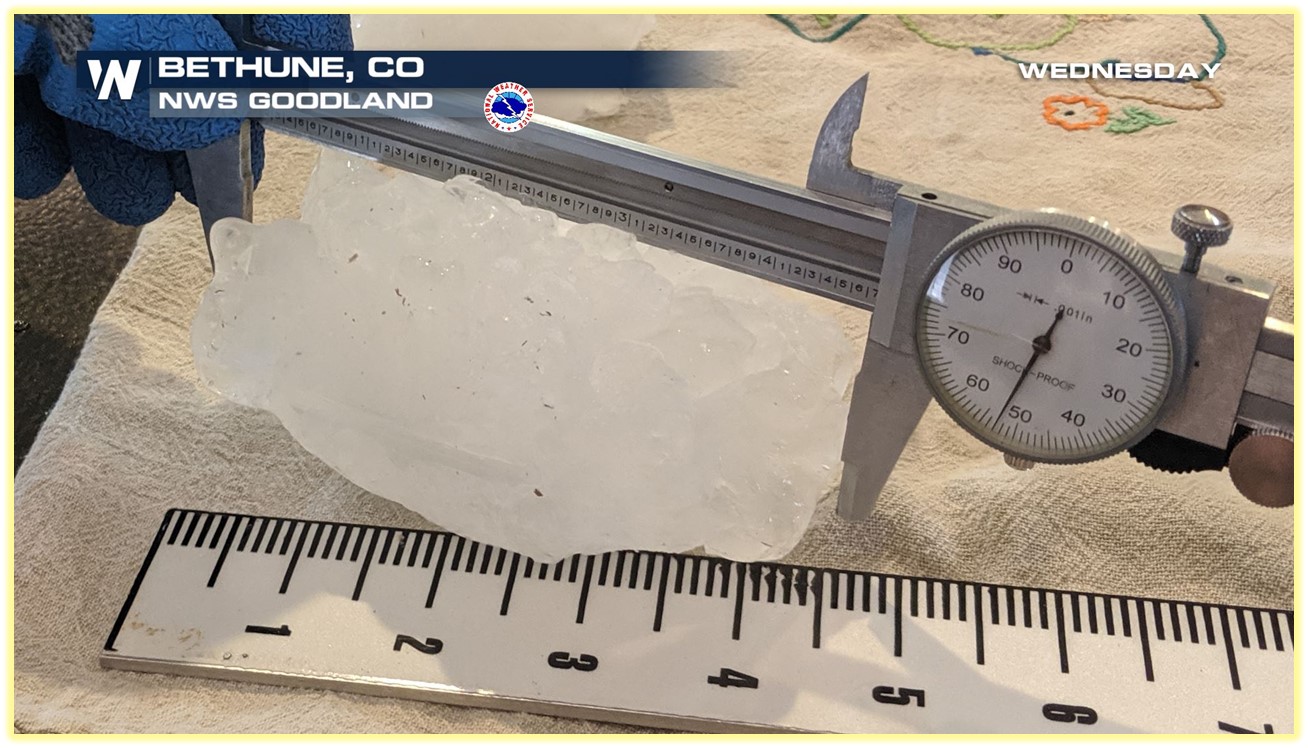
Colorado’s Largest Hailstone 8/13: 4.85”, 8.5 Ounces
Colorado's Most Costly Hail Storms
With the exception of the May 22, 2008, Windsor tornado and the hail storm that hit Pueblo on July 29, 2009, Colorado's ten most costly hail storms were centered in the Denver Metro area (which makes sense, because that's where the largest concentration of property in the state is located).
Date
Location
Cost When Occurred
(Millions)
2026 Dollars
(Millions)*
May 8, 2017
Denver Metro
$2.3 Billion
3.09 Billion
July 20, 2009
Denver Metro
$767.6
$1.18 Billion
July 11, 1990
Denver Metro
$625.0
$1.57 Billion
June 6-15, 2009
Denver Metro
$353.3
$543
July 28, 2016
Colorado Springs
$352.8
$485
June 6-7, 2012
CO Front Range
$321.1
$462
June 13-14, 1984
Denver Metro
$276.7
$879
June 18-19, 2018
North Denver and Denver Metro
$276.4
$363
July 29, 2009
Pueblo
$232.8
$358
October 1,
1994
Denver Metro
$225.0
$501
September 29, 2014
Denver Metro
$213.3
$298
May 22, 2008
Windsor
$193.5
$297
*2026 estimated cost calculations based on the Consumer Price Index.
New Mexico Hail Statistics
Tornadoes and hail resulted in $16.5 million dollars in insured damage around Clovis, Roswell and Logan March 23, 2007.
In September 2006, hail caused $10 million in insured losses in and around Las Cruces.
May 10, 2005, Hobbs, New Mexico's hailstorm caused approximately $21 million in insured losses.
In June 2005, Lovington, New Mexico experienced $13.7 million in claims resulting from hail.
In early Ocober 2007, Albuquerque experienced $40 million in insurance claims due to hail.
What to Do After a Hail Storm
First, if a hail storm strikes, don't go out in the storm to try to protect your
property. You could be injured.
Check trees, shrubs and plants around your house. If they are stripped
of their foliage, there is a possibility that your roof is damaged. You
should
also check for roof damage if patio covers, screens or soft
aluminum roof
vents are dented.
Check your car for dents and broken or cracked glass.
Protect your property from further damage.
If you find signs that hail has battered your property, take immediate steps to protect it from further damage.
Cover any broken windows and holes in your roof so that no water can enter and damage your home's interior.
Cover any broken glass in your car to prevent damage to the interior from rain and remove glass from the car's interior to prevent cuts in upholstery and carpet.
File your claim
Call your agent or company as soon as you notice damage. Practically all homeowners policies cover hail damage. You car will be covered if you've purchased comprehensive coverage.
If your agent or company requests you to do so, follow up your call with a written explanation of what happened.
Save receipts for what you spend and submit them to your insurance company for reimbursement.
Select a repair company.
After an insurance adjuster has surveyed the hail damage to your property, select a reputable roofing company or auto body shop to make repairs.
Allow only the insurance adjuster and roofer you have selected to get up on your roof. Each time someone walks on it, more damage can occur.
Be wary of out-of-town roofers who move into an area and set up shop following a storm. While most of these firms are reputable, some have collected money from homeowners and moved on to the next storm site without paying suppliers or leaving work unfinished. This can leave homeowners holding the bag for those additional costs. It's a good idea to select a company with established credibility and local references. Word of mouth is still your best guide.
Be sure roofers have workers compensation and liability insurance. If they don't, you may be held liable if one of the workers is injured or if they damage a neighbor's property.
Don't make final payment to the roofing company until your roof has been inspected and you are satisfied.
Use hail resistive roofing materials.
Installing a hail-resistant roof is an important investment in reducing homeowners insurance premiums in hail-prone states. Many companies provide discounts for roofs that meet the Insurance Institute for Business & Home Safety’s Fortified standards. Reversely, wood shake or non-hail resistant roofs will add to what you pay for insurance and increase your deductible. Additionally, not having to replace your roof after a hailstorm will help you avoid non-renewal of insurance for multiple claims.
IBHS and its members recognized the growing problem of hail damage in large regions of the United States and have devoted years to field and lab research to develop a new test standard for impact resistance.
To conduct testing, IBHS bought the major competing widely purchased impact-resistant shingles from standard distribution channels accessible to consumers, brought them to our lab, and tested them under scientifically replicated real-world conditions. The results offer unprecedented insights into the performance of shingles labeled as impact resistant.
Click here for more information on IBHS and their FORTIFIED Roof/Hail Information.
Click here for IBHS Impact Resistant Test Protocol for Asphalt Shingles




 First, if a hail storm strikes, don't go out in the storm to try to protect your
property. You could be injured.
First, if a hail storm strikes, don't go out in the storm to try to protect your
property. You could be injured.