|


|
|
|


WildfireColorado Wildfire Information For those impacted by the 2026 Colorado Wildfires, please use the below links for more information :
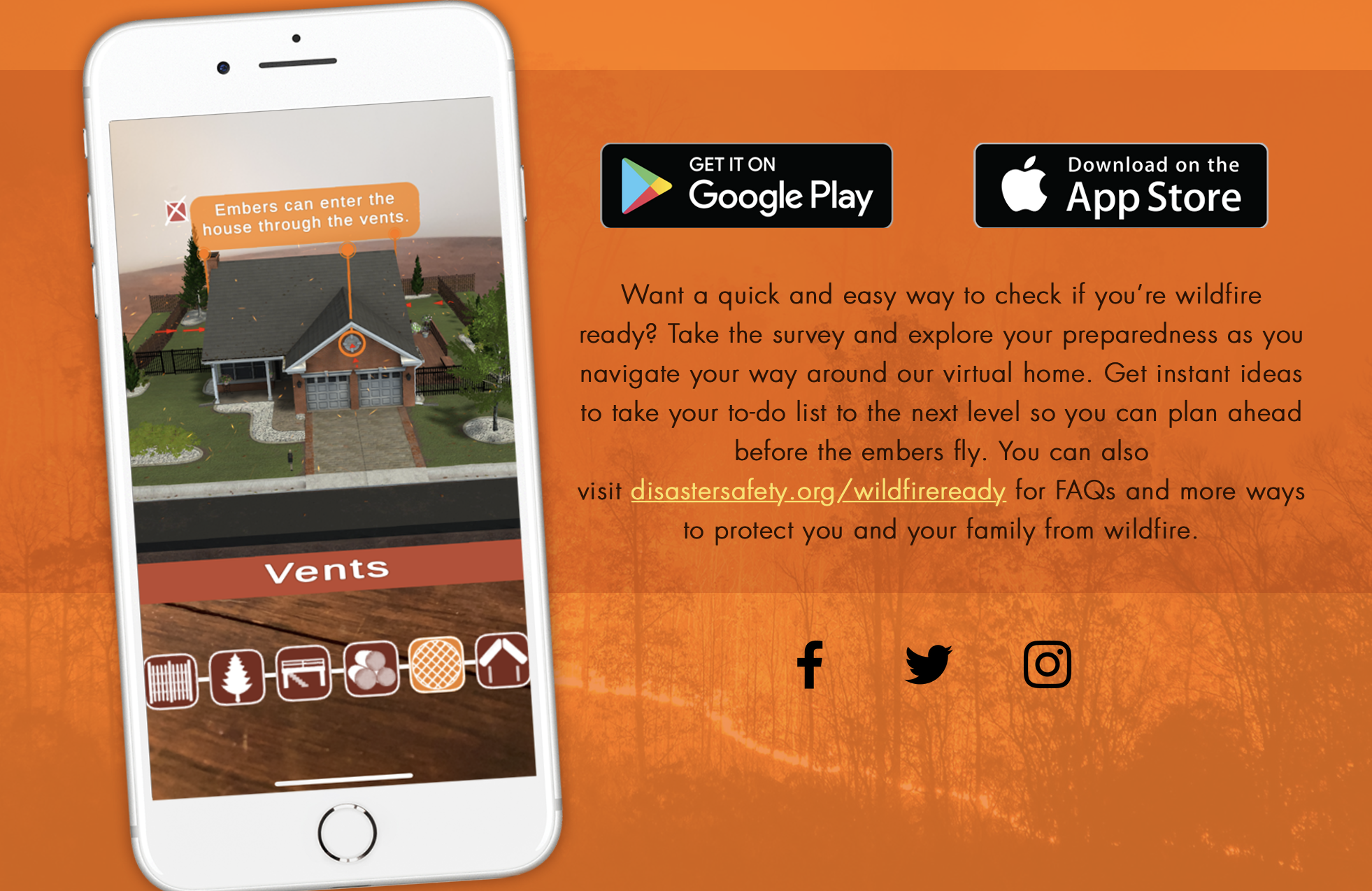
Wildfire is a growing threat in the Rocky Mountain Region, where population is booming in the mountains and foothills. People don't always realize the dangers of living in the Red Zones (dangerous wildfire areas). They move to Colorado, Utah, Wyoming and New Mexico for the breathtaking views, but they don't always see the potential for losing their homes to wildfire. Homeowners need to be aware of the steps they should take to prevent wildfire AND be aware of the insurance impact before moving or building in high-risk areas. Want a quick and easy way to check if you’re wildfire ready? Take the survey and explore your preparedness as you navigate your way around our virtual home. Get instant ideas to take your to-do list to the next level so you can plan ahead before the embers fly. You can also visit disastersafety.org/wildfireready for FAQs and more ways to protect you and your family from wildfire. Click here to go to IHBS to see how to download their wildfire app.
The cost of wildfire-resilient construction in Colorado How much more does it cost to build a wildfire-resistant home in Colorado?
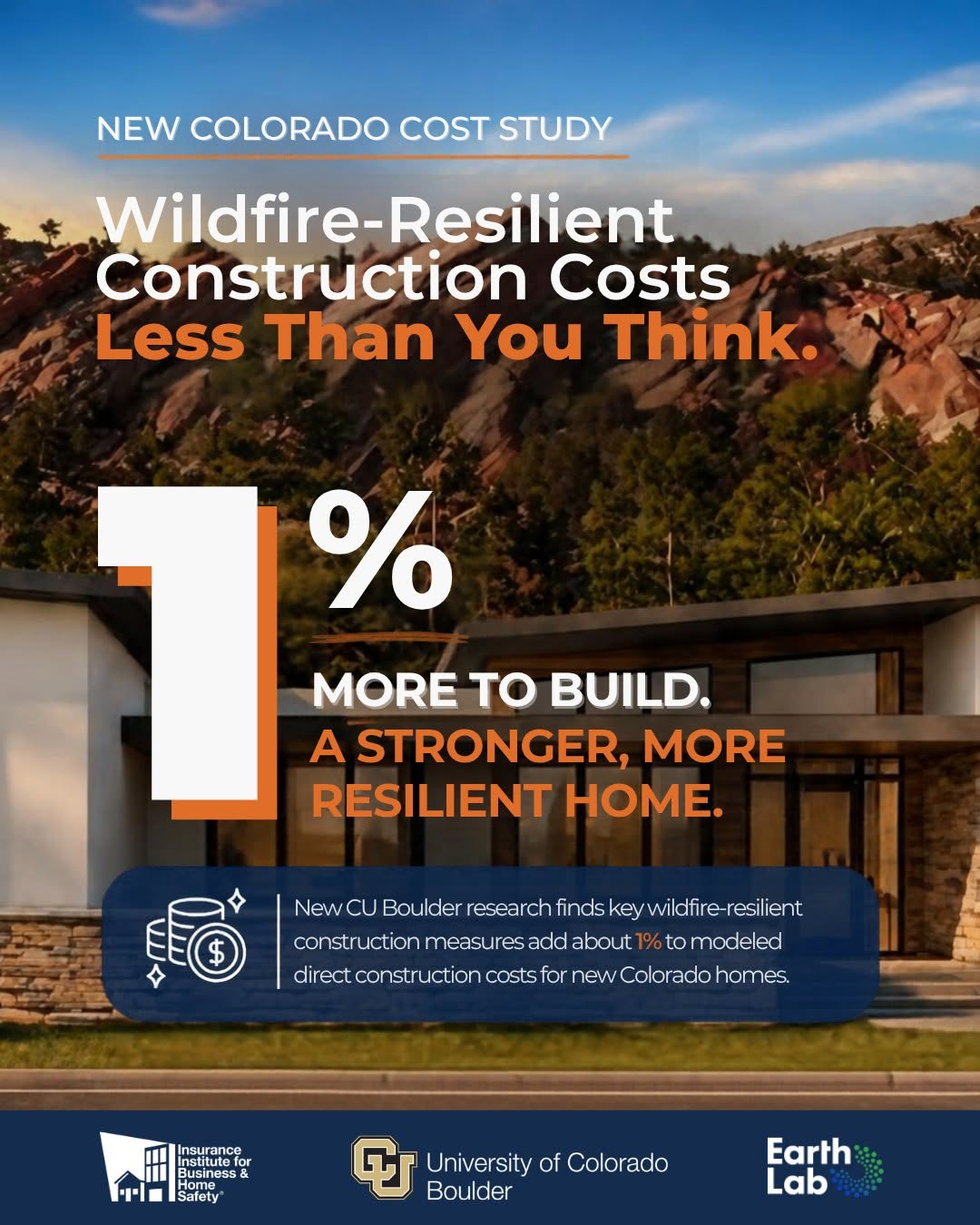
The latest research from University of Colorado Boulder’s Earth Lab, University of Colorado Boulder found that incorporating key wildfire-resilient construction measures into new Colorado homes adds just 1% to modeled direct construction costs.
These insights will help pave the way for future wildfire-resilient construction. Click here to download the study
The most costly wildfire in Colorado history is the December 30, 2021 Marshall Fire in Boulder County and while recovery is still in progress insured preliminary insured damage estimates top at least $2 billion with 1,089 lost and 149 significantly damaged. The Marshall Fire raged through Superior, Louisville and unincorporated Boulder County pushed by more than 100 mile per hour straight line winds destroying suburban neighborhoods in less than 24 hours. The 2020 wildfire season was the most active wildfire year on record across the west with the 3 largest wildfires in Colorado history and 5 of the 6 largest in California history. While the rebuilding process continues for Colorado's two largest fires, damage estimates for the East Troublesome and Cameron Peak fire now total $614 million ($795 in 2026 dollars) from insurance claims that include smoke damage, additional living expenses, damaged and destroyed homes, as well as personal belongings and vehicles. The October 2020 East Troublesome Fire in Grand County is the second most costly Colorado wildfire with estimated insured losses totaling $543 million ($703 in 2026 dollars) resulting from approximately 1,602 homeowner and auto insurance claims filed. Officials put the number of destroyed homes at 366. The Waldo Cayon Fire in Colorado Springs burned 346 homes and based on 6,648 claims filed, the insurance costs are estimated at $453.7 million ($662 in 2026 dollars) The High Park Fire near Fort Collins burned 259 homes, and based on the 1,293 insurance claims filed, the insurance costs are estimated at $113.7 million ($165.9 in 2026 dollars). Previously, the most expensive wildfire in Colorado state history was the September 2010 Fourmile Canyon Fire that burned 169 homes and other personal property in the foothills just northwest of Boulder. Damage estimates totaled $217 million ($333.5 million in 2026 dollars) from insurance claims that included smoke damage, additional living expenses, damaged and destroyed homes, as well as personal belongings and vehicles. The overall estimated cost of the 2002 Colorado wildfire season including the Iron Mountain, Coal Seam, Missionary Ridge and Hayman Fires was $70.3 million in insured losses ($130.9 million in 2026 dollars). Companies took in about 1,236 claims for the Hayman and Missionary Ridge Fires at an estimated cost of $56.4 million ($105 million in 2026 dollars). The insurance industry estimates the Cerro Grande Fire in Los Alamos cost approximately $140 million in insured damage in May 2000 ($272 million in 2026 dollars), making it the most costly wildfire in New Mexico's history. Nationally, The Camp Fire, the deadliest and costliest wildfire in U.S. history, began on Nov. 8, 2018, killing 85 people and causing $8.47 billion in insured losses in Butte County, California. (Source: California Department of Insurance). The insured loss dollar figure represents the payouts to customers as of May 2019 from the 28,118 auto, residential, and commercial property insurance claims generated from the Camp Fire event. The Insurance Information Institute estimates insurance losses will total $10.5 billion. https://www.insurancejournal.com/news/national/2019/11/06/547719.htm Previously, the most costly fire in terms of insured losses was the 2017 Tubbs fire which caused $8.7 billion in insured losses (about $11.8 billion in 2026 dollars) and 2018 Woosley Fire at $4.2 billion (about $4.6 billion in 2026 dollars). Catastrophic fires account for 1.5% of insurance losses. That compares to 39.1% for tornadoes, 40.8% for hurricanes and tropical storms, 6.2% for terrorism, 6.8% for winter storms, .1% for earthquakes and 5.4% for wind/hail damage (as reported by the Insurance Information Institute). As many as 90 percent of wildland fires in the United States are caused by humans, according to the U.S. Department of Interior. Some human-caused fires result from campfires left unattended, the burning of debris, downed power lines, negligently discarded cigarettes and intentional acts of arson. The remaining 10 percent are started by lightning or lava. Wildfire insurance costs hinge on a number of factors, including the number of primary homes in the area (as compared to vacation homes and cabins), their estimated value and the amount of insurance coverage on the properties. Colorado Wildfire Insurance Costs
*2026 estimated cost calculations based on the Consumer Price Index. Top 10 costliest wildland fire in the United States ($ in billions)
1Property losses only for catastrophic fires. Effective January 1, 1997, ISO's Property Claim Services (PCS) unit defines catastrophes as events that cause more than $25 million in insured property damage and that affect a significant number of insureds and insurers. From 1982 to 1996, PCS used a $5 million threshold in defining catastrophes. Ranked on dollars when occurred. As of August 8, 2019. 2Adjusted for inflation through 2018 by the Insurance Information Institute using the GDP implicit price deflator. 3Insurance Information Institute estimate based on data from catastrophe risk modelers, reinsurance companies, the California Department of Insurance, and the Property Claims Services unit of Verisk Analytics. These estimates are preliminary because the organizations involved periodically resurvey the events, and the severity of losses and other factors create a high level of uncertainty surrounding the ultimate loss figures. Source: Insurance Information Institute, catastrophe risk modelers, reinsurance companies, the California Department of Insurance, the Property Claim Services® (PCS®) unit of ISO®, a Verisk Analytics® company, and the U.S. Bureau of Economic Analysis. Fighting Wildfire with Innovation - November 2019 paper by iii.org Explore which communities have been threatened by nearby wildfires from 2000 to 2019. • Nearly 2.000 communities saw a wildfire of 100+ acres burn within two miles between 2000 and 2019. • Nine cities with more than 500,000 residents have been threatened by wildfires. • Most homes are lost or damaged due to embers, which can travel a mile or more ahead of a wildfire front * Communities can increase wildfire resiliency by hardening homes to ember ignitions. Taken from Headwaters Economics Website - www.headwaterseconomics.org How can I slow down a wildfire headed toward my house?
Here is an interview with a homeowner who experienced the Fourmile Canyon Fire near Boulder, Colorado. Hear how he helped save his home. Video provided by State Farm. Tips for helping prevent a wildfire from destroying your home:
Coloradans overwhelmingly consider wildfire mitigation an important personal responsibility of homeowners who live in high risk wildfire areas, and the majority of Coloradans feel there should be insurance consequences for those who refuse to take steps to protect their property from the threat of wildfire. A January 2015 statewide independent poll commissioned by the Rocky Mountain Insurance Information Association found that 96 percent of Coloradans said it is "very important" or "pretty important" for homeowners to undertake fire mitigation efforts. View complete 2015 poll results here. How can I help firefighters save my home?
For more information, please see Allstate's Wildfire Evacuation Tips: What Can You Do To Make Sure You're Ready? In case of possible evacuation – only if you have enough warning – consider packing the following items:
What should I do after a wildfire?
Also Visit: |
 Make it easy for firefighters to get to your home. Roads need to be wide enough to accommodate fire trucks, and there has to be a place for them to turn around. Driveways and bridges must be strong enough to carry heavy emergency vehicles. Identify at least two ways to and from your house and make sure they're well marked. All access routes to your home should be free of low hanging tree branches and cleared of flammable vegetation at least 10 feet from roads and five feet from driveways.
303-790-0216 • 800-355-9524 • Contact Us • Legal Notice, Disclaimer & Terms of Use
Home • About RMIIA • News Room • P&C Insurance Industry • Auto • Homeowners • Business • Catastrophes • Agent Resources • Events & Education • Brochures